Bharathi Vijayappa
Recruiter became People Architect: one metaphor that cut the audience from five to two, and a foundation wide enough to carry the company and community coming next.
The Challenge
Bharathi had the resume most personal brands only pretend to have. Twenty years in recruitment, hundreds of founders placed, enough stories to fill a book, a recruitment business that was actually working, a community that kept growing around her.
None of it showed up online.
She was doing everything the internet tells experienced professionals to do: post consistently, use AI, talk about hiring, share career tips. What came out the other end was competent. It could have been written by any recruiter with twenty years in the game. She was documenting her expertise instead of building authority with it.
The real problem wasn't the writing. It was that she was trying to talk to everyone in the hiring ecosystem at once:
- Founders
- Candidates
- Recruiters
- HR leaders
- Working professionals
Every post diluted the last one. And because none of the messaging was anchored to who Bharathi actually was, AI just amplified whatever was already generic.
The Discovery
We didn't start with colours, logos, or a content calendar (the instinct every brand project has to fight off first). We started with conversations, a lot of them.
Instead of asking what she wanted to post, we asked why people had trusted her for twenty years. The same few stories kept coming up:
- Driving across the city at 7am because a candidate mattered
- Carrying a founder's hiring problem like it was her own company's
- Walking away from long standing relationships the moment trust broke
- Meditation, solo travel, the habit of drawing a hard boundary and holding it
None of these read like content ideas. They read like the same instinct, playing out in different rooms: entering complicated human situations, reading what was actually going on beneath them, and helping people make a better call.
That was the insight the whole brand ended up standing on.
The Strategy
Once we saw that, the recruitment brand stopped making sense. We built around human judgment instead.
The positioning got narrower and, because of that, stronger:
- Instead of recruitment, Bharathi would talk about clarity
- Instead of hiring processes, she'd talk about the decisions underneath them
- Instead of sounding like one more recruiter with a newsletter, she'd become the person founders and experienced professionals went to when they were stuck on a hard call
We cut the audience down hard too, to just two people:
- Founders building teams
- Professionals navigating career decisions
Everyone else, recruiters, HR leaders, the wider hiring crowd, moved from primary audience to a supporting one.
Trying to write to five audiences was how she'd ended up writing to none.
The Central Metaphor
One idea kept surfacing across our discovery sessions: Bharathi wasn't hiring people into companies, she was designing the human structure the company grows inside. That's where People Architect came from.
An architect doesn't start with where the walls go. They start with the people who'll live and work inside the space, because the building exists to serve them, not the other way round.
Bharathi works the same way. Before she'll talk job descriptions or hiring strategy, she wants to understand:
- The founder and the business
- The stage it's at
- The culture they're trying to build
- The kind of people who'll actually thrive inside it
The team comes after, not before.
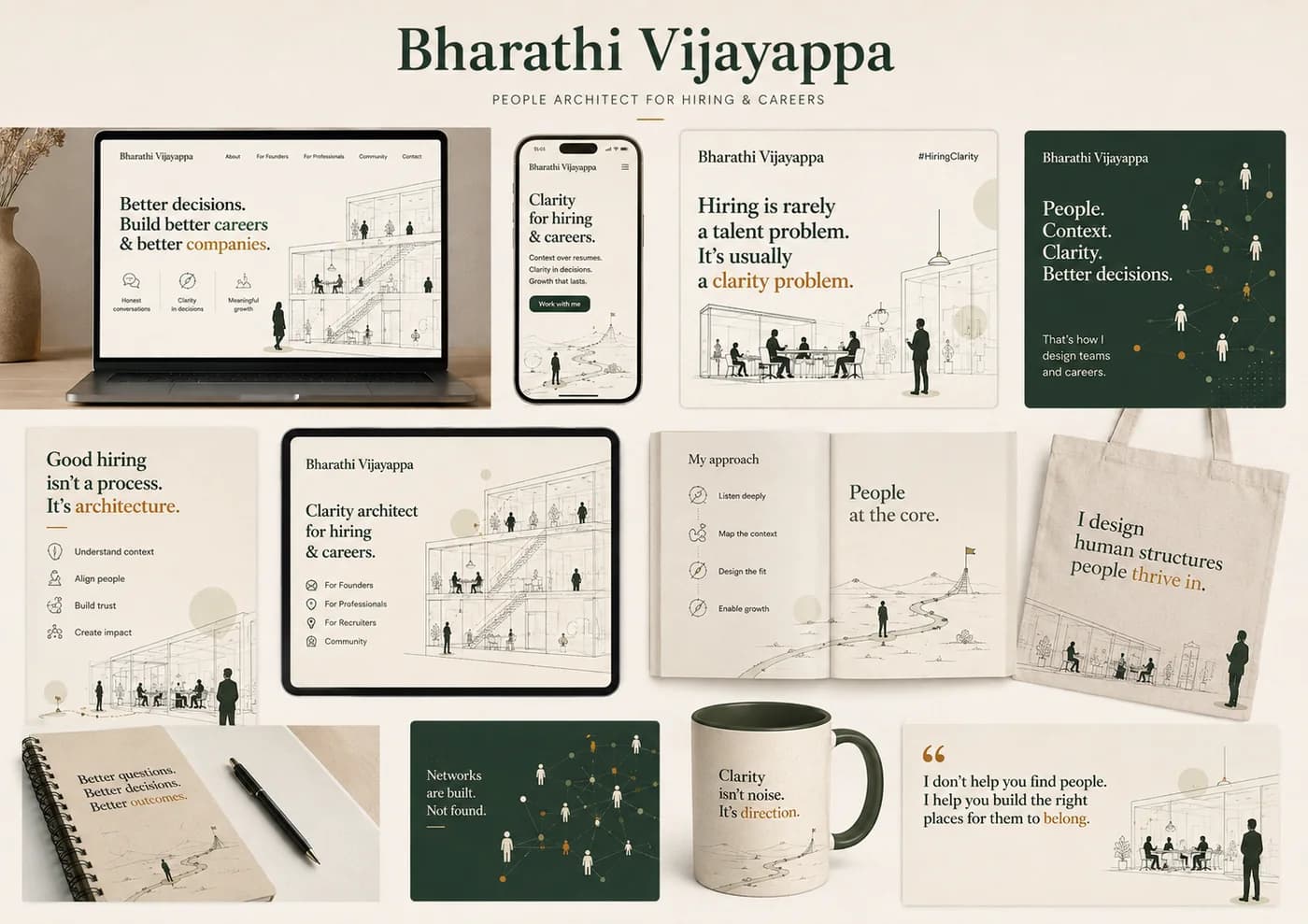
That's not filling vacancies. That's designing an organisation around human needs and long term relationships. That single distinction ended up shaping her language, her positioning, and eventually the way the brand looked. Office buildings became outlines instead of finished objects, with the people inside them as the actual visual focus.
Every illustration made the same point: the structure serves the people, never the reverse.

The Brand System
With the strategy settled, every layer of the brand got rebuilt around it:
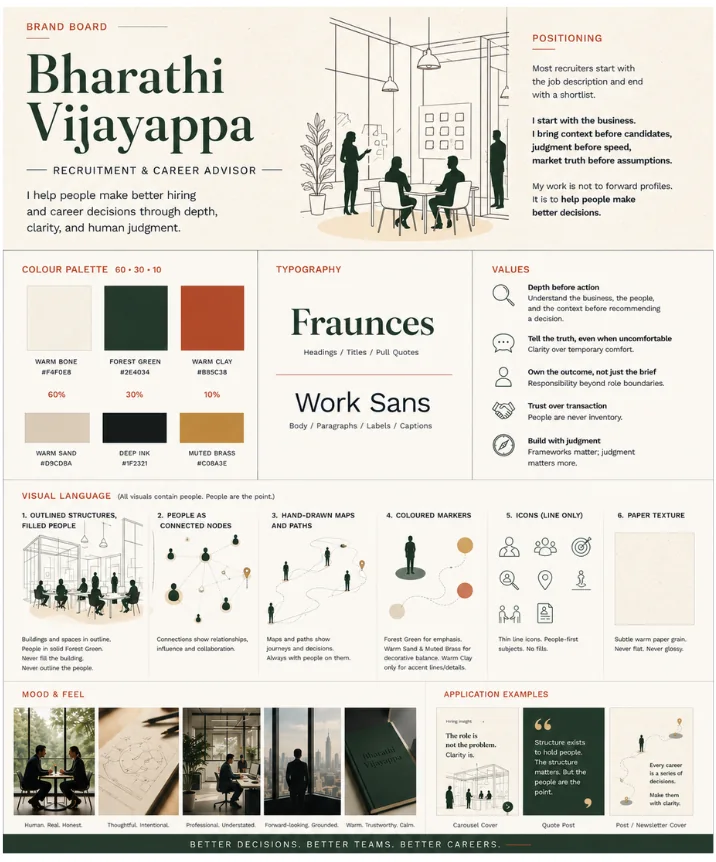
- A full messaging system covering positioning, voice, audience, and content principles
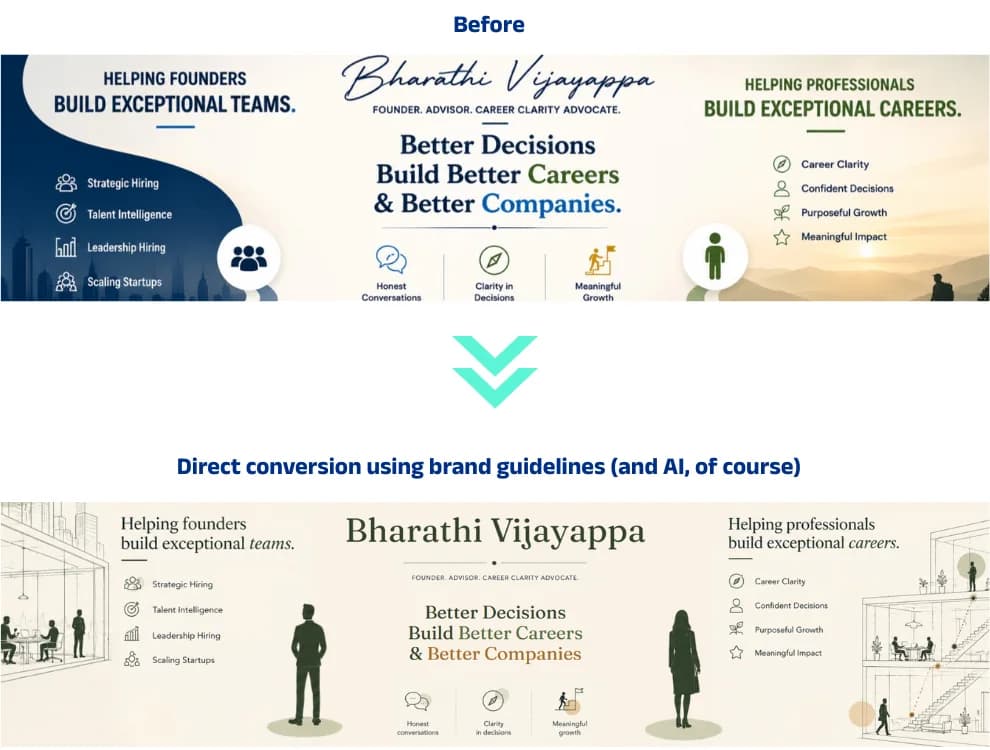
- A visual identity built around human structures instead of the usual corporate polish
- A restrained editorial palette
- Fraunces paired with Work Sans for typography
- Hand-drawn offices filled with people rather than empty architecture
- Connected nodes and pathways standing in for the way people move through work
The content changed too. AI stopped generating posts from prompts and started working inside Bharathi's own thinking and language, more of a writing partner than a content machine.
The goal was never to sound more polished. It was to sound like Bharathi and only Bharathi.
The Outcome
The brand holds together now because every piece traces back to the same belief. Recruitment is the context. Human judgment is the story.
And none of it was built just for the content calendar. The positioning, the metaphor, the visual language, all of it was built wide enough to carry two things Bharathi is already moving toward:
- Her own company, built on the same People Architect thinking
- A new community for working professionals navigating career decisions
Getting the foundation right once means she won't be rebuilding the brand from scratch every time the business grows into something new.
Across messaging, visuals, and content, Bharathi is easier to remember, easier to trust, and considerably harder to mistake for the next recruiter posting career tips.
The part that seems to matter most to her: she's stopped feeling like she's outsourcing her personality to AI.
The brand sounds like the person who earned twenty years of trust, not the job title she happened to hold while earning it.
Rather than simply creating a brand for me, he helped me uncover it.
Working with Abhishek on my personal brand has been a truly eye-opening experience. Rather than simply creating a brand for me, he helped me uncover it.
The questions he asked made me reflect deeply, not just about who I am, but also about my business and the impact of some of the most meaningful projects I've worked on. That process gave me a level of clarity I hadn't expected.
What I appreciated most was that I never felt like I was outsourcing my branding. Instead, Abhishek guided me to do the work myself. He challenged my thinking, gave me the right frameworks, and helped me build a brand that genuinely feels like my own. That's a rare quality.
Like many entrepreneurs, I used to think branding and marketing were only for large companies with big budgets. Abhishek showed me that every founder has a story worth telling and, more importantly, that you can learn to tell it yourself.
If you're looking for someone who helps you build clarity, not dependency, I highly recommend Abhishek. He's the go-to person for personal branding.
Want something like this?
Start with a free BrandDNA, or tell me what you are building.